
 View menu
About VNK's
VNK's is committed to delivering high-quality products that meet the stringent demands of customers and the market, ensuring we uphold our initial promises.




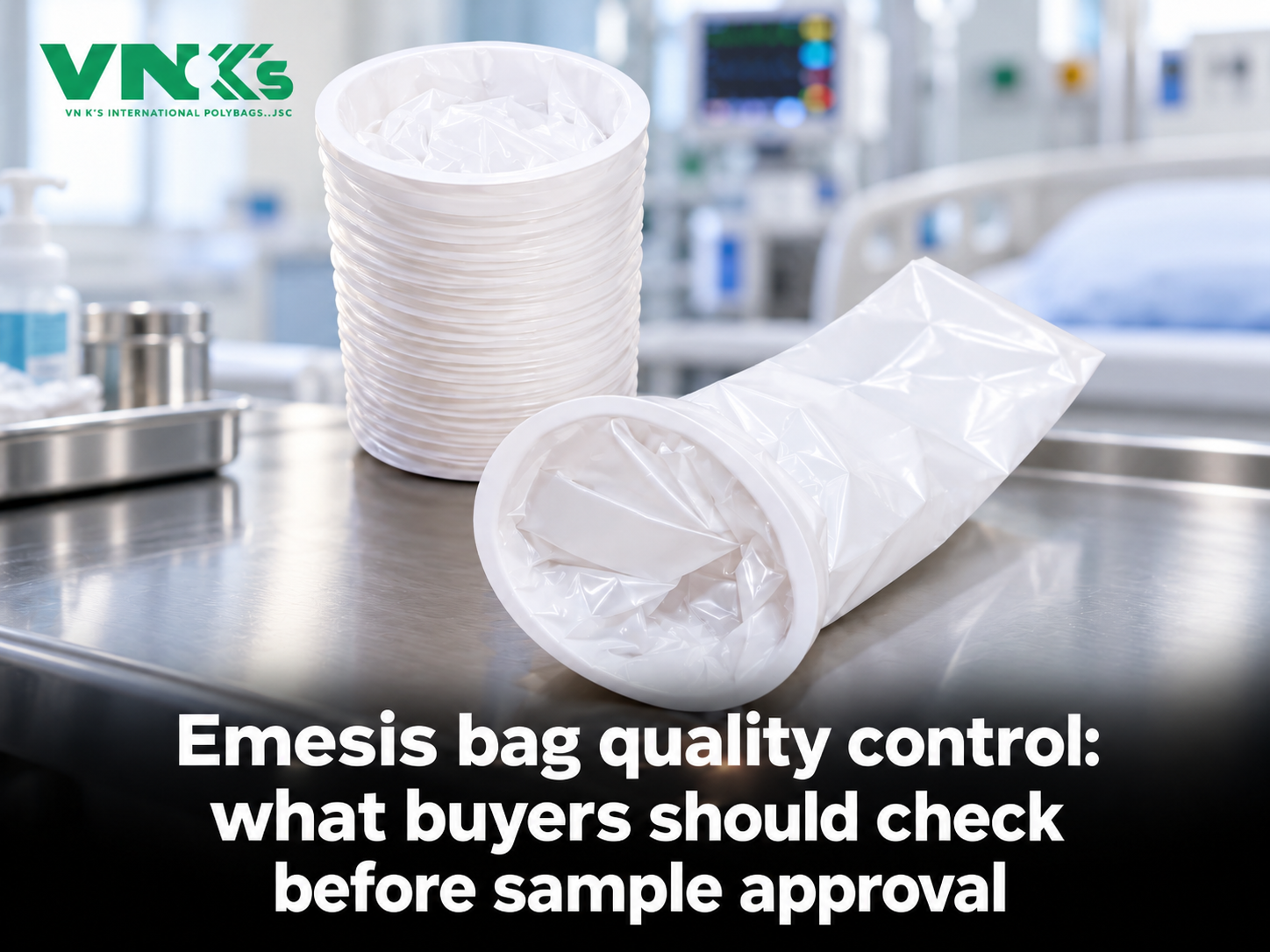




Two emesis bag samples may have the same dimensions, stated film thickness and a similar appearance. Those details alone, however, are not enough for an importer or distributor to conclude that both meet the same quality requirements.
During sample approval, the question is not simply whether the bag feels strong. Buyers need to know which parts have been evaluated, how they were tested and what acceptance criteria were used. Reviewing the film, seals and finished-bag results separately makes discussions with the manufacturer more specific and useful.
Thickness is one specification to verify, not an overall verdict on emesis bag quality. Before comparing samples, buyers should confirm the required material, target thickness and any agreed tolerance.
In particular, clarify whether the thickness refers to a single layer of film or a measurement taken through several layers of a folded bag. Results taken at different locations or through different numbers of layers cannot be compared directly.
Check the film beyond its stated thickness
The inspection plan should identify measurement locations, the number of readings and suitable equipment. A single convenient measurement should not be assumed to represent the entire bag body. Folded areas and seals need to be distinguished when selecting measurement points.
For visual inspection, record visible holes, cuts, unusual areas of film or difficulty separating the two sides when opening the sample. Describe these observations and assess them against the agreed criteria rather than simply reporting that the film “looks poor.”
The impression that a sample feels thick, soft or stiff does not replace measurement data or the required performance evaluations.
Where the design includes bottom or side seals, inspect each location according to the actual construction. Do not assume that every emesis bag has the same seal arrangement.
Points to record include interruptions in the seal, wrinkles crossing the sealed area, misaligned edges or signs of film damage. Full-bag photographs together with close-up images help the manufacturer locate the area requiring review.
A visual observation alone does not establish the manufacturing cause. For example, a wrinkle should not automatically be attributed to an incorrect sealing temperature. The sample and relevant information need to be reviewed before identifying the cause or corrective action.
Conversely, a seal that looks uniform does not prove that the bag meets its strength or leakage requirements. Visual inspection is part of the evaluation, not a substitute for the necessary testing.
For bags with a plastic ring, specify whether the inspection scope includes the connection between the bag body and the ring. Results from a bottom-seal test do not establish the quality of that separate connection.
These evaluations answer different questions:
| Evaluation | Question to answer |
|---|---|
| Water-leak check | Is water observed leaking through the sample under the specified test conditions? |
| Seal-strength test | How does a specimen containing the seal respond to force, and how does it fail under the selected method? |
A sample with no leakage detected in a particular test has not necessarily met every strength requirement. Likewise, a satisfactory force result from one section of seal does not establish that there are no leak locations elsewhere in the finished bag.
When reviewing strength results, buyers should request the failure mode as well as the measured force: did the seal separate, or did the film tear elsewhere? A force value without the method and failure details may not provide a sound basis for comparing samples.
For leak evaluation, the way the bag opening is closed or supported also needs to be documented. An emesis bag has an open mouth to receive its contents, so sample preparation must suit the evaluation objective. A method intended for a closed package should not automatically be applied unchanged.
Test methods must be selected and confirmed as suitable for the product construction. This article does not prescribe a mandatory test standard for all emesis bags.
A sample-testing video can support a discussion, but without the test conditions it is not enough to compare two sources of supply.
The buyer and manufacturer should agree on:
– Sample identification, specification revision and the number of samples to evaluate.
– The test objective and the areas of the product being assessed.
– Sample preparation, positioning or support, equipment and test method.
– The applied conditions and test duration appropriate to the method.
– Acceptance criteria, result recording and the response to any irregularities.
For a liquid-based evaluation, define the liquid, fill quantity and test conditions. Do not assign one filling level or duration to every design without an appropriate basis.
Conclusions should remain within the scope of the evidence. For example, “no leakage was detected in the samples under the recorded conditions” is a more precise statement than “the bags will never leak.”
Sample approval also does not mean that every subsequent shipment has been inspected. Lot sampling and acceptance requirements need to be agreed separately.
Buyers can use the following table as a discussion framework. It does not describe VNK’s current QC procedure or standard acceptance criteria.
| Review item | Information to record |
|---|---|
| Sample identification | Sample code, date received and specification revision |
| Bag film | Required material, single-layer thickness, measurement locations and results |
| Visual inspection | Location and description of any irregularity, with reference photographs |
| Seals | Area evaluated, method, results and failure mode where force testing is performed |
| Leakage | Method, conditions, sample count and any identified leak locations |
| Acceptance criteria | Agreed requirements and points still awaiting confirmation |
| Decision | Accept, request clarification or request a revised sample |
Can a thicker bag be approved straight away?
No. Thickness needs to meet the specification, but it does not replace seal evaluation or other finished-bag requirements.
Can a sample be approved by pulling it by hand?
A manual pull may help identify an initial irregularity, but without a controlled method it does not provide comparable quantitative results. Where a force-based criterion is required, both parties need to agree on a suitable method.
VNK’s is a plastic bag manufacturer in Vietnam supporting OEM and custom manufacturing projects. When discussing emesis bags, buyers can provide a specification, reference photographs or a physical sample to help clarify their requirements.
VNK’s sales team can review the information and identify missing details or points requiring confirmation before production. Specific test methods and acceptance criteria need to be clarified for each project.
Send your enquiry to VNK’s with your reference sample and existing quality requirements. Information that has not yet been defined can be marked for further discussion.

The optimal solution for your order at the most competitive price.