
 View menu
About VNK's
VNK's is committed to delivering high-quality products that meet the stringent demands of customers and the market, ensuring we uphold our initial promises.





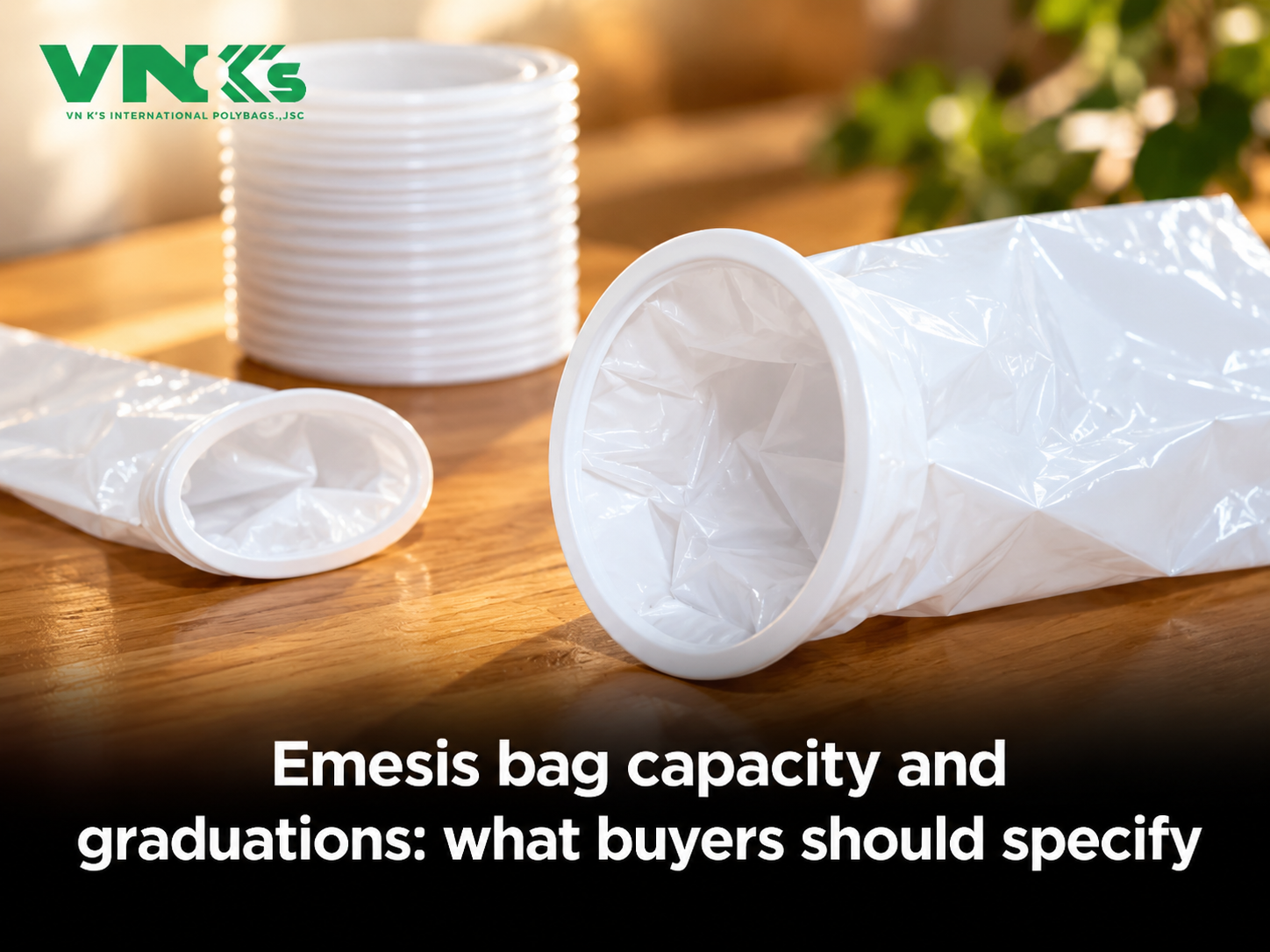




An enquiry for a “1,000 ml emesis bag” may seem clear to a distributor. For the manufacturer, however, that figure still needs clarification: does it describe the bag’s stated capacity or the highest marking on its printed volume scale?
For medical supply importers and distributors, resolving this distinction helps prevent the manufacturer, purchasing team and end user from interpreting the same product differently. Before approving a sample, buyers should separate their requirements for capacity, graduations and any specified fill limit rather than combining them into a single number.
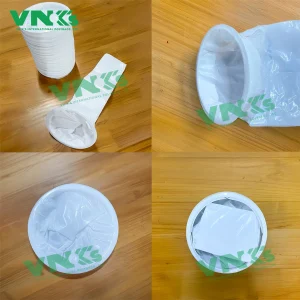
Emesis Bag
Stated capacity is the volume listed in the manufacturer’s product documentation. Buyers should ask how that value was determined instead of assuming it represents an acceptable filling level under every condition of use.
The graduated range is the span of volumes shown by the markings and numbers printed on the bag. The highest printed marking should not automatically be treated as the bag’s stated capacity.
A fill limit, where specified by the manufacturer, is a separate detail to check in the instructions for that particular product. Neither the stated capacity nor the highest graduation should be substituted for that limit without confirmation.
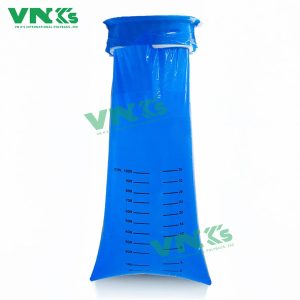
The graduated range is the span of volumes shown by the markings and numbers printed on the bag
These three fields should appear separately in the specification:
| Specification field | What the buyer should clarify |
|---|---|
| Stated capacity | The value and the basis used to determine it |
| Graduated range | The first and last markings, including the unit |
| Fill limit, if specified | The value and the manufacturer’s applicable instructions |
If the documentation gives only a value in ml without explaining its meaning, request clarification before using it in a catalogue or passing it on to a customer.
“With graduations” is not a complete requirement for artwork approval. Buyers should specify the unit, the volume levels to be marked and how the numbers should appear on the bag.
State the unit, such as ml, clearly in both the artwork and the specification. If a customer requests two measurement systems, check the unit labels and conversions before approval rather than copying numbers from a reference photograph.
The graduation interval is the difference in volume between adjacent markings. For example, requesting markings at 100 ml intervals is different from requesting numbers at only a few principal levels. Buyers need to define both the markings and which of them require numerical labels.
More graduations do not, by themselves, demonstrate greater accuracy. Readability and the basis for evaluating the scale must be considered separately.
The artwork should identify which side carries the scale, its reading direction and its position relative to seals or folds on the finished sample. During the agreed evaluation, check for unclear or incomplete numbers, overlap with other printing, and markings that become obscured.
Do not approve the scale solely from a flat artwork file. Printing on the finished bag should also be checked against the approved design.
For results to be comparable, the buyer and manufacturer should agree on how the bag will be positioned or supported during evaluation. Results obtained under different conditions should not be compared as though the evaluation methods were identical.
A sample evaluation plan can define:
– The sample identification and artwork revision being reviewed.
– How the bag will be positioned or supported, including how folds will be handled.
– The volume points to be checked and suitable reference equipment.
– The number of samples, how results will be recorded and the acceptance criteria.
These are matters to agree on for the project, not a standard test procedure that automatically applies to every emesis bag.
Approving clear numbers and correct artwork does not establish volume measurement accuracy. If a customer specifies a tolerance or intends to use the readings within a professional procedure, appropriate documentation and an evaluation method are needed for that requirement. A bag should not be described as a calibrated measuring device simply because it has printed graduations.
The following example is an initial enquiry for discussion. It is not a standard VNK’s specification or a commitment to supply the proposed configuration.
| Item | Initial requirement and points to confirm |
|---|---|
| Product | Emesis bag with a plastic ring and printed volume scale |
| Stated capacity | Manufacturer to propose a value and explain how it is determined |
| Graduated range | Proposed range of 100 ml to 1,000 ml, subject to suitability review |
| Graduation interval | Proposed 100 ml intervals; confirm which markings require numbers |
| Unit | ml |
| Scale placement | Identify on a drawing or reference sample |
| Fill limit, if applicable | To be confirmed against the product design and instructions |
| Evaluation conditions | To be agreed before sample approval |
| Tolerances and acceptance criteria | Not yet defined; further discussion required |
| Reference materials | Full-bag photographs, clear images of the scale and a physical sample if available |
Material, dimensions, thickness, packing and quantity requirements still need to be provided for the order. This table addresses only capacity and graduations.
The important point is to keep unknown information clearly marked as pending confirmation. A specification with identifiable open questions is easier to discuss than a fully populated document whose figures have not been understood and agreed upon.
Can capacity be established from the bag’s layflat dimensions alone?
Layflat dimensions should not be treated as sufficient evidence of capacity. Request information about the finished sample and the manufacturer’s basis for determining the stated volume.
Is a sample photograph enough to approve graduation placement?
A photograph is useful for communicating initial requirements. For approval, buyers should also review a drawing or artwork with clearly defined placement and an appropriate finished sample.
VNK’s is a plastic bag manufacturer in Vietnam supporting OEM and custom manufacturing projects. For an emesis bag enquiry, buyers can begin with the information they already have, provide reference images or send a physical sample for specification discussion.
VNK’s sales team can review the initial information and identify missing details or points requiring confirmation before production. Specific requirements for capacity, graduations and evaluation criteria need to be clarified for each project.
Send your enquiry to VNK’s with your current sample or specification. List the required capacity, graduated range and any unresolved questions separately so both sides can work through the details.

The optimal solution for your order at the most competitive price.